


Delta
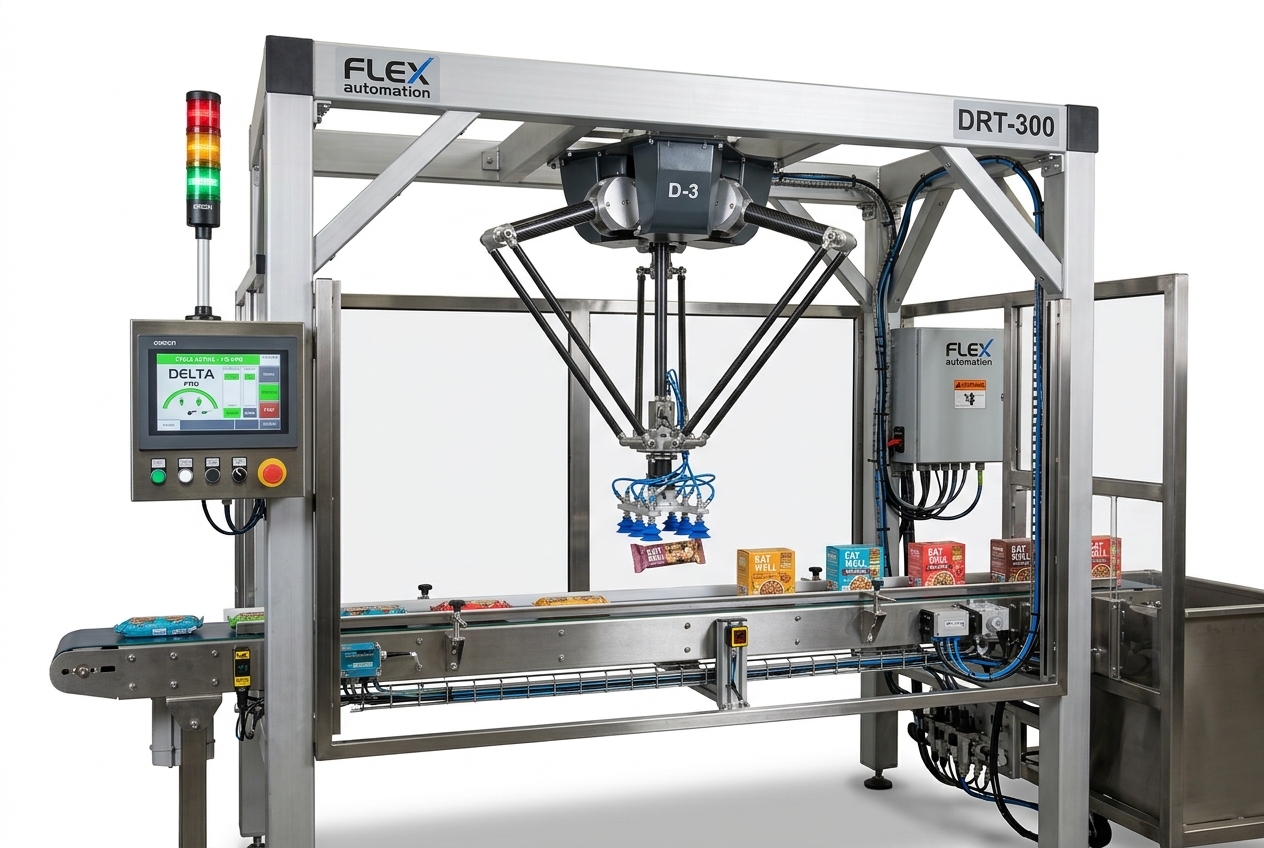
A delta robot is a parallel robotic system designed for fast, repetitive movements and precise product handling. Its lightweight moving structure and multiple connected arms allow it to perform rapid pick-and-place operations within a defined working area. Delta robots are commonly considered for applications that require products to be picked, transferred, sorted, or positioned at high speed.
A delta pick and place robot can automate repetitive handling tasks across manufacturing, packaging, and product-sorting processes. Depending on its configuration, it can pick products from a conveyor, reposition them, and place them into trays, containers, or other designated locations. Integration with suitable grippers, sensors, conveyors, and control systems helps coordinate the robot with the wider production line.
A high speed delta robot is particularly suitable for applications involving lightweight products and frequent pick-and-place cycles. The choice between a 3 axis delta robot and a 4 axis delta robot depends on the movement and orientation required by the application. Payload, reach, cycle time, product characteristics, and working-area requirements should all be evaluated before selecting a suitable configuration.
Key Highlights of Delta Robots
Designed for high-speed, repetitive pick-and-place operations.
Supports rapid product transfer within a defined workspace.
Suitable for handling lightweight products and components.
Can be integrated with conveyor systems and automated production lines.
Supports selected food and consumer product packaging applications.
Can work with compatible vision systems for product detection and positioning.
Available in configurations suited to different movement requirements.
Can be evaluated for sorting, product placement, and case-packing processes.
What Is a Delta Robot?
A delta robot is a parallel robot that uses multiple connected arms attached to a fixed base to control a moving platform or end effector. Its lightweight moving components and mechanical arrangement allow rapid movements, making it suitable for repetitive handling operations that require speed and consistent positioning.
A 3 axis delta robot typically performs movement along three linear directions within its working envelope. It is commonly considered for picking and placing products where additional rotational movement is not required. A 4 axis delta robot adds rotational movement of the end effector, allowing suitable products to be reoriented during transfer.
The choice between these configurations depends on product orientation, handling requirements, payload, reach, and production speed. Grippers, sensors, vision systems, and conveyor tracking can also be integrated when required by the application.
Applications of Delta Robots
Delta Pick and Place Robot
A delta pick and place robot automates the transfer of products between predefined positions. It can pick products from a conveyor or feeding station and place them into trays, containers, or designated locations according to a programmed sequence.
Typical applications include:
Sorting products by position or type.
Transferring lightweight components between stations.
Placing products into trays or containers.
Arranging items before packaging.
Moving products between connected production processes.
The gripper and robot configuration should match the product's shape, weight, surface, and handling requirements.
Delta Robot for Packaging
A delta robot for packaging can automate product picking, orientation, grouping, and placement before or during selected packaging operations. Its suitability depends on the product format, packaging arrangement, required cycle time, and integration with the packaging equipment.
When connected to conveyors and suitable control systems, a delta robot can coordinate product handling with the wider production process. Proper application planning helps prevent interruptions caused by inconsistent product feeding or mismatched machine speeds.
Delta Robot for Food Packaging
A delta robot for food packaging can be used for handling suitable food products and packaged items in automated production environments. Applications may include picking individual products, arranging items into trays, sorting products, and transferring them toward downstream packaging equipment.
Food-related installations require appropriate hygiene provisions, suitable materials for the application, and cleaning procedures. Product fragility, temperature, moisture, and contact requirements should also be considered when selecting the gripper and configuring the robot.
Delta Robot with Vision System
A delta robot with vision system combines robotic handling with camera-based product detection and positioning. The vision system can identify product locations, determine orientation, or provide coordinates that guide the robot during pick-and-place operations.
This setup can be useful when products arrive at varying positions or require visual identification before handling. Performance depends on lighting, camera placement, image processing, calibration, controller compatibility, and the characteristics of the products being handled.
Vision integration should be planned around the actual application to ensure that product detection and robotic movement operate as a coordinated system.
Delta Robot Conveyor Tracking
Delta robot conveyor tracking allows a compatible robotic system to pick products from a moving conveyor rather than requiring every item to stop at a fixed position. Sensors or vision equipment detect product locations, while the control system coordinates robot movement with conveyor motion.
This approach can support continuous product handling in suitable high-speed packaging and sorting applications. Successful implementation depends on conveyor speed, product spacing, detection accuracy, robot cycle time, and synchronisation between the conveyor and robot controller.
Delta Robot for Case Packing
A delta robot for case packing can support selected product-transfer and placement operations associated with carton or case preparation. Depending on the product and application, it may arrange lightweight items into groups before they are placed into cases.
The complete system must be assessed for product dimensions, grouping patterns, payload, reach, and required throughput. Delta robots are not suitable for every case-packing task, particularly where products are heavy or require complex handling outside the robot's working envelope.
Benefits of Using a Delta Robot
High-Speed Product Handling
A high speed delta robot is designed for rapid repetitive movement within its operating envelope. It can be useful for production processes involving frequent picking, sorting, and placement of lightweight products. Actual performance depends on the payload, travel distance, tooling, motion settings, and complete application cycle.
Consistent Product Placement
Automated movements can improve repeatability when transferring products between defined positions. Consistent results depend on proper calibration, suitable tooling, stable product presentation, and reliable control of the overall process.
Reduced Repetitive Manual Work
Delta robots can automate selected repetitive handling tasks, reducing the need for continuous manual picking and placement. This allows employees to focus on monitoring, quality checks, process supervision, and other production responsibilities.
Integration with Automated Lines
A delta robot can be integrated with compatible conveyors, sensors, vision systems, and packaging equipment. Proper integration helps coordinate product movement between process stages and supports a more organised production workflow.
Industries That Use Delta Robots
Food and Beverage
Suitable applications include handling selected food products, sorting items, arranging products into trays, and supporting packaging processes. Hygiene, cleaning, and product-contact requirements are important considerations.
Pharmaceutical and Healthcare
Delta robots may support the handling and placement of suitable packaged products and components. Applications must account for cleanliness, product protection, inspection, and applicable quality requirements.
FMCG and Consumer Goods
Fast-moving consumer goods operations can use delta robots for repetitive sorting, product grouping, and transfer into packaging stations, depending on product weight and handling requirements.
Electronics and Electrical Components
Selected lightweight components can be picked, sorted, and placed into trays or fixtures. Appropriate grippers and handling parameters help protect delicate products.
Plastics Manufacturing
Delta robots can handle suitable lightweight moulded components, sort parts, and transfer products between production stages. The robot's cycle time should be compatible with the output of the connected machine.
Packaging and Logistics
Delta robots can support sorting, product grouping, and transfer operations within suitable automated packaging and handling systems. Conveyor layout, product spacing, and required throughput are important selection factors.
How to Choose the Right Delta Robot
Selecting the right delta robot requires a clear understanding of the application and production targets. Consider these factors before choosing a configuration:
Axis configuration: Choose between a 3 axis or 4 axis arrangement according to the required movement and product orientation.
Payload capacity: Include the product weight and the weight of the gripper or end-of-arm tooling.
Working envelope: Confirm that the robot can reach all required pick-up and placement positions.
Cycle time: Evaluate whether the complete application can achieve the target production rate.
Product characteristics: Consider size, shape, weight, fragility, and surface material.
Gripper selection: Match the handling tool to the product and application.
Vision requirements: Determine whether cameras or sensors are needed for detection and orientation.
Conveyor tracking: Assess whether products must be picked from a moving conveyor.
Integration requirements: Check compatibility with packaging equipment, controllers, and other connected machinery.
Safety and maintenance: Plan suitable safeguarding, operator access, and routine maintenance.
Evaluating these factors helps establish whether a delta robot is appropriate for the intended task and production environment.
Delta Robot Price in India
The delta robot price in India depends on the robot configuration, payload, working envelope, speed requirements, end-of-arm tooling, and integration complexity. A standalone robot may have a different cost from a complete automated cell equipped with vision systems, conveyors, safety devices, and packaging equipment.
When comparing quotations, consider the full project scope, including programming, installation, commissioning, operator training, and ongoing technical support where applicable. These factors can influence the total investment beyond the cost of the robotic arm itself.
Before requesting a quotation, define the product being handled, required pick-and-place sequence, target cycle time, expected production volume, and available workspace. This information helps determine the technical requirements of the application.
Why Choose OSTECH for Delta Robot Automation?
Delta robot integration requires careful coordination between the robot, product-handling tools, sensors, conveyors, and production equipment. The selected configuration should match the application and work reliably within the intended operating environment.
When evaluating a delta robot manufacturer in India, delta robot supplier, or delta robot distributor, consider technical suitability, integration capabilities, the scope of supply, and after-sales support. Reviewing these factors helps identify a solution aligned with the production requirements.
Key considerations when planning a delta robot project include:
Defining the application and production targets.
Selecting suitable robot specifications.
Matching the gripper to the product.
Evaluating conveyor and vision integration.
Checking required cycle time and product spacing.
Assessing workspace and safety requirements.
Testing the system with representative products.
Planning maintenance and operator training.
A well-planned robotic system can support consistent product handling and reduce repetitive manual work in suitable manufacturing and packaging applications.
Explore More: Articulated Robotic Arm
Different industrial applications require different robotic configurations depending on payload, reach, movement complexity, and production requirements. An articulated robotic arm is another option for applications that require multi-axis movement and greater flexibility in positioning and orientation.
Explore the Articulated Robotic Arm to learn more about robotic automation for industrial handling, pick-and-place, and suitable manufacturing applications.
Related Products
Frequently Asked Questions
We provide conveyor systems, automatic case packers, wrap-around case packers, and custom material handling systems designed to increase production line efficiency.