Manufacturing is no longer only about making a good product. It is about getting that product packed, protected, and shipped quickly and consistently, even as order volumes rise and product ranges expand. Traditional packaging machines are fast, but they are often built for one product and one format. Manual packing is flexible, but it is slow, tiring, and hard to scale.
Robotic arms bridge this gap. They bring speed, precision, and flexibility to packaging tasks that once needed human hands, and they are changing how modern plants are designed. This article explains how robotic arms work in packaging, where they deliver the biggest benefits, and what to consider before adding them to your line.
What Are Robotic Arms in Packaging?
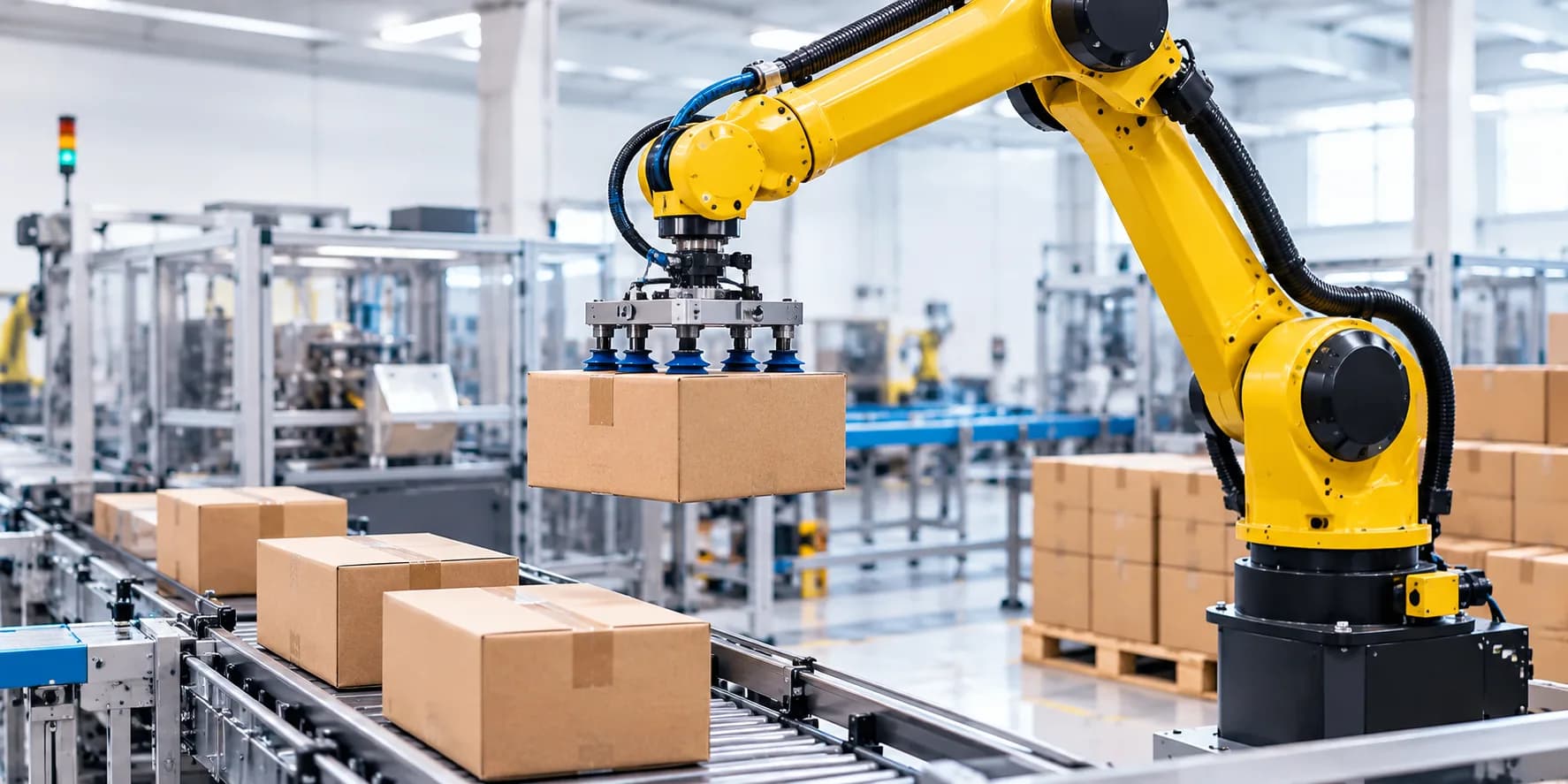
A robotic arm is a programmable machine with multiple joints that can move, pick, rotate, and place items with high repeatability. In packaging, it is fitted with a tool at the end, such as a vacuum gripper or mechanical fingers, so it can handle products, cartons, or cases.
Combined with sensors and, often, vision systems, a robotic arm can identify product position, adjust its movement, and place items accurately even when they arrive at slightly different positions on a conveyor.
Where Robotic Arms Are Used in Packaging
Robotic arms are used at many stages of the packaging process:
Pick and place: lifting products from a conveyor and placing them into trays, cartons, or cases
Case packing: loading products into shipping cases in the correct pattern
Palletizing: stacking finished cartons onto pallets for storage or dispatch
Sorting and orienting: arranging products before packing
Loading and unloading: feeding machines or moving items between stations
This range of tasks is why robotic arms are now a common part of end-of-line packaging automation.
Key Ways Robotic Arms Are Transforming Packaging
1. Greater Flexibility Across Products
A traditional machine is often built around specific product dimensions. A robotic arm can be reprogrammed and fitted with different grippers, which lets one system handle several product types, sizes, and packing patterns. This flexibility is valuable for plants with many SKUs or frequent format changes.
2. Consistent Accuracy and Quality
Robotic arms repeat the same movement with the same precision every time. That means uniform carton loading, correct orientation, and more professional shipments. Consistency also reduces packing errors and rework.
3. Less Product Damage
Controlled, programmable motion allows gentle handling. Speed, grip force, and placement can be tuned for each product, which helps reduce damage to fragile items such as glass bottles, delicate containers, and soft packs.
4. Reduced Manual Handling
Repetitive lifting, sorting, and placing are tiring and increase the risk of strain and error. Robots take over these tasks, improving ergonomics and workplace safety. Rather than replacing people, this lets teams focus on supervision, quality control, and problem solving.
5. Faster and More Stable Output
Robotic systems can run through long shifts without fatigue, which keeps output steady and makes production planning easier. When integrated well with upstream machines, they help prevent end-of-line bottlenecks.
6. Better Use of Floor Space
Robotic arms can often be arranged in compact layouts and reach several positions from a single base. In plants with limited space, this can be a practical alternative to several large standalone machines.
7. Smarter, Connected Production
Modern robotic systems can communicate with conveyors, inspection units, and control software. This supports data collection, better monitoring, and the move toward smart, connected manufacturing.
Robotic Arms vs Traditional Packaging Machines
Robotic arms do not replace every dedicated machine. Each approach has strengths:
Factor | Robotic Arm | Traditional Machine |
Flexibility | High, with programmable movements and changeable grippers | Lower, built around set formats |
Changeover | Often quicker through stored programs | Can need mechanical adjustments |
Best for | Mixed products, varied patterns, frequent changes | Stable, high-volume, single-format production |
Layout | Compact and adaptable | Fixed design |
Typical use | Pick and place, case packing, palletizing | Dedicated high-speed packing |
For very high-volume, single-product lines, a dedicated machine such as a twin head case packer may be the better fit. For lines with several products and frequent changeovers, a flexible system such as a combi case packer or a robotic cell may offer more value. Many plants combine both approaches.
Industries Benefiting from Robotic Packaging
Food processing: packing snacks, bakery items, frozen foods, and ready meals with gentle, consistent handling
Beverage: loading bottles, cans, and cartons, then palletizing cases
Pharmaceutical: accurate, repeatable packing that supports quality standards and reduces manual handling
FMCG and consumer goods: high-volume packing with frequent product and pack changes
Personal care: handling varied container shapes with care
Logistics and warehousing: sorting, case handling, and palletizing
What to Consider Before Adding Robotic Arms
Robotic automation delivers the best results when it is planned carefully. Review the following before you invest:
Product characteristics: size, weight, shape, fragility, and surface type, which affect gripper choice
Speed requirements: the output you need per minute or per hour, including peak periods
Variety of products: how many SKUs and pack formats you run, and how often they change
Line integration: how the robot connects with upstream and downstream equipment, including conveyor systems, inspection units, and sealing machines
Floor space and layout: reach, safety zones, and operator access
Safety: guarding, sensors, and clear operating procedures
Support and training: commissioning, operator training, spare parts, and technical assistance
Total cost of ownership: purchase price, energy, maintenance, and the labour and quality savings over time
Starting with a clear picture of your goals prevents overspending on features you do not need and helps ensure the system delivers a real return.
Common Challenges and How to Avoid Them
Poor product presentation: robots need products presented consistently, so good infeed design matters
Unrealistic speed expectations: confirm real-world speed with your actual products
Weak integration: a robot working alone will not fix a poorly connected line
Skipping trials: test with real products and packs before committing
Ignoring training: well-trained operators keep the system running smoothly
Addressing these early protects your investment and shortens the time to productive output.
Why Choose OSTECH?
Successful automation takes more than advanced machinery. It requires industry experience, careful planning, and dependable support. OSTECH designs end-of-line packaging automation and industrial automation solutions built around real manufacturing challenges.
Our expertise includes:
Case packing machines
Conveyor systems and conveyor integration
Customized packaging automation
Industrial automation solutions
End-of-line packaging systems
Every solution is developed around your production requirements, so machines, conveyors, and automation work together as one reliable line. If your products or layout need something specific, we can develop a customized equipment solution that fits your process.
Final Thoughts
Robotic arms are changing automated packaging and manufacturing by combining speed, precision, and flexibility in one adaptable system. They reduce manual handling, improve packing consistency, protect products, and help plants respond quickly to changing demand. The best results come from matching the technology to your products, volumes, and layout, and from integrating it properly with the rest of your line. With careful planning and the right automation partner, robotic packaging can improve efficiency today and support growth for years to come.