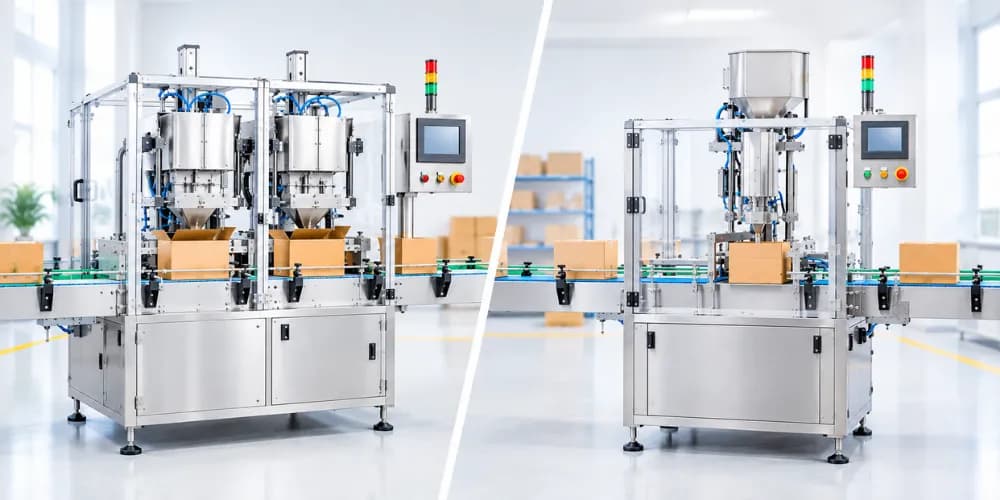
Choosing between a twin head and a single head case packer is one of the most common decisions manufacturers face when they automate the end of their line. Both machines pack products into cartons accurately and consistently. The difference lies in speed, footprint, cost, and how well each one matches your production volume.
Pick a machine that is too small and it becomes a bottleneck. Pick one that is too large and you pay for capacity you never use. This guide compares the two configurations side by side so you can decide which one fits your line, your products, and your growth plans.
Why the Right Case Packer Matters
A case packing machine does more than drop products into boxes. It sets the pace of the end of your line, protects products from handling damage, and reduces the repetitive manual work that drives up labour costs and errors.
The right choice can help you:
Keep pace with filling or forming output
Improve packing consistency from shift to shift
Reduce product damage during packing
Lower labour and operating costs
Support future production growth
Selecting equipment on price alone often leads to higher maintenance costs and lost productivity over time, so it pays to compare configurations carefully.
What Is a Twin Head Case Packer?
A twin head case packer uses two packing heads working together to load products into cases. Because two heads share the work, the machine can handle higher throughput and keep up with fast, continuous production.
Twin head systems are typically chosen for:
High-volume manufacturing
Continuous, multi-shift production
Faster packaging cycles
Lines where one case packer must match very fast upstream equipment
The trade-off is a larger footprint and a higher investment, so the machine makes the most sense when your volume genuinely needs the extra capacity.
What Is a Single Head Case Packer?
A single head case packer uses one packing head to pick and place products into cases. It delivers reliable, consistent packing for moderate production volumes without the cost and space of a larger system.
Single head systems are typically chosen for:
Small and medium manufacturers
Moderate production volumes
Limited floor space
Cost-effective automation as a first step
The trade-off is a lower maximum throughput, so you should check that the machine can handle your peak output and any growth you expect.
Twin Head vs Single Head Case Packer: Side-by-Side Comparison
Factor | Twin Head Case Packer | Single Head Case Packer |
Packing heads | Two | One |
Throughput | Higher | Moderate |
Best for | High-volume, continuous production | Moderate volumes, growing businesses |
Floor space | Larger footprint | Compact footprint |
Initial investment | Higher | Lower |
Scalability | Strong headroom for growth | May need an upgrade if volume rises sharply |
Typical users | Large manufacturers | Small and medium manufacturers |
Use this table as a starting point. Your own products, carton sizes, and shift patterns will decide how much each factor matters.
Key Factors That Decide the Right Choice
1. Production Volume and Speed
Start with the numbers. How many products do you pack per hour at peak? How many shifts run each day? If your upstream machines produce more than a single head can pack, a twin head is the safer choice. If your output is moderate and steady, a single head will usually do the job well.
2. Future Growth
A machine should serve you for years. If you expect volume to rise sharply within a few years, a twin head may save you from replacing equipment early. If growth is gradual and uncertain, a single head lets you automate now and expand later.
3. Available Floor Space
Twin head systems need more room. Measure your available space, including access for operators and maintenance. In compact plants, a single head case packer often fits where a larger system cannot.
4. Product Characteristics
Size, weight, shape, and fragility affect how products should be picked and placed. Bottles, pouches, cartons, and containers each need different handling. Whichever configuration you choose, ask the supplier to test your actual products.
5. Budget and Total Cost of Ownership
The purchase price is only part of the picture. Consider energy use, maintenance, spare parts, downtime, and the labour savings the machine delivers. A cheaper machine that runs below your needs can cost more in the long run than a better-matched one.
6. Line Integration
Your case packer must work smoothly with everything around it. Check compatibility with:
Poor integration is a common cause of unplanned stops, so confirm it before you buy.
When Should You Choose a Twin Head Case Packer?
A twin head case packer is likely the better fit if:
Your line runs at high speed for long hours
You pack large volumes of the same or similar products
Upstream machines would otherwise outpace a single head
You expect significant volume growth
You have the floor space and budget for a larger system
When Should You Choose a Single Head Case Packer?
A single head case packer is likely the better fit if:
Your production volume is moderate and predictable
Floor space is limited
You want cost-effective automation without overspending
You are automating manual packing for the first time
You may expand capacity later as the business grows
What If You Pack Multiple Products?
If your plant runs several products, formats, or carton sizes, speed alone may not be the deciding factor. Quick changeovers and flexibility can matter more. In that case, a combi case packer, which combines several packing operations in one compact system, is worth comparing alongside twin and single head options.
Questions to Ask Before You Decide
What speed can the machine sustain with my specific products?
How long does a changeover take between formats?
Can it integrate with my existing line and controls?
What do installation, commissioning, and training include?
What support and spare parts are available after installation?
Can the machine be upgraded if my production grows?
Final Thoughts
There is no single best answer between a twin head and a single head case packer. The right choice depends on your production volume, available space, budget, and growth plans. Twin head systems deliver higher speed and capacity for demanding lines, while single head systems offer cost-effective, compact automation for moderate volumes. Define your requirements first, test the machine with your own products, and choose the configuration that fits today's needs with room to grow.