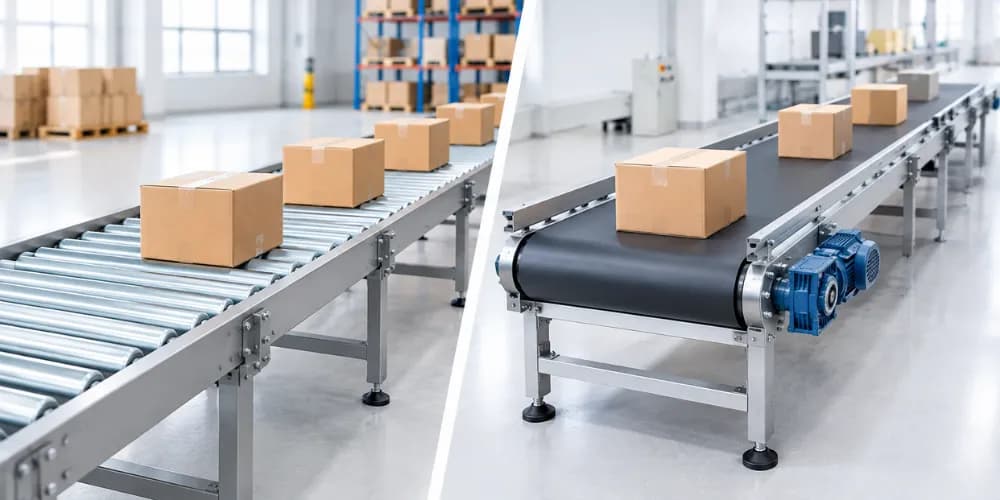
Conveyors are the backbone of almost every manufacturing and packaging operation. They move products between machines, workstations, and storage areas, keeping production flowing without manual carrying. Yet choosing the wrong type can cause product damage, jams, and constant maintenance.
Two of the most common options are roller conveyors and belt conveyors. They may look similar from a distance, but they behave very differently depending on what you move, how fast you move it, and where it is used. This guide compares them side by side so you can decide which one suits your products, your line, and your industry.
Why Choosing the Right Conveyor Matters
A conveyor is more than a transport path. It affects how smoothly products move, how well your machines work together, and how reliable your line is every day. A well-chosen conveyor can:
Keep products flowing without stoppages
Reduce manual handling and labour costs
Protect products from damage and misalignment
Improve workplace safety
Support future production growth
A poorly matched one creates bottlenecks that no amount of fast machinery can fix. Whichever type you choose, it should fit your products and your wider conveyor system design.
What Is a Roller Conveyor?
A roller conveyor moves products over a series of rollers mounted in a frame. Products travel either by gravity, by manual pushing, or by powered rollers driven by a motor or chain.
Roller conveyors work best with items that have a firm, flat bottom surface, such as cartons, boxes, crates, totes, and pallets. Because the rollers support the load directly, they handle heavy items well and are simple to maintain.
Key characteristics:
Suited to rigid, flat-bottomed products
Available in gravity and powered versions
Good for accumulation and sorting
Easy to inspect, clean, and repair
Common in packing, dispatch, and warehouse areas
What Is a Belt Conveyor?
A belt conveyor carries products on a continuous belt that runs over pulleys. The belt provides a continuous surface, so it can carry items of many shapes and sizes, including small, loose, or irregular products.
Belt conveyors are widely used where products need smooth, controlled movement and where small items could fall between rollers. Different belt materials suit different environments, from food-grade surfaces to heavy-duty industrial belts.
Key characteristics:
Suited to small, loose, soft, or irregular products
Provides a continuous, stable surface
Allows controlled speed and smooth transfer
Works on inclines and declines with the right belt
Common in food, pharmaceutical, and general manufacturing lines
Roller Conveyor vs Belt Conveyor: Side-by-Side Comparison
Factor | Roller Conveyor | Belt Conveyor |
Best for | Cartons, boxes, crates, totes, pallets | Small, loose, soft, or irregular items |
Product surface | Needs a firm, flat base | Handles many surface types |
Support | Rollers carry the load | Continuous belt surface |
Power options | Gravity or powered | Powered |
Accumulation | Well suited | Possible, with the right setup |
Inclines | Limited | Generally easier with suitable belts |
Maintenance | Simple roller and bearing checks | Belt tracking, tension, and wear checks |
Typical areas | Packing, dispatch, warehousing | Production, inspection, food, and pharma lines |
Use this table as a starting point. Your actual products, speeds, and layout will decide which factors matter most.
Key Factors to Consider When Choosing
1. Product Type and Shape
This is the most important question. Rigid cartons and boxes travel well on rollers. Small, soft, or loose items need the continuous surface of a belt. If a product could tip, snag, or fall through gaps, a belt is usually the safer option.
2. Load Weight
Roller conveyors handle heavy loads well because the rollers carry the weight directly. For very heavy or palletized loads, roller systems are often the practical choice. Always confirm the load rating with your supplier.
3. Speed and Control
Belt conveyors give smooth, controlled movement, which suits inspection, sorting, and precision handling. Roller conveyors suit steady transport and accumulation. Match the conveyor to the pace your line actually needs.
4. Layout, Inclines, and Space
Check your floor plan. If products must move up or down, or around tight spaces, the layout may favour belts. For straight runs in packing and dispatch areas, rollers are often simpler and more economical.
5. Hygiene and Environment
In food, pharmaceutical, and similar industries, cleanability matters. Belts with suitable materials can be easier to wash down, while open roller designs can be easy to inspect. Consider moisture, dust, temperature, and cleaning routines before deciding.
6. Maintenance and Total Cost of Ownership
Consider more than the purchase price. Think about spare parts, cleaning time, wear, energy use, and downtime. A conveyor that suits your product will usually cost less to run over its lifetime.
Which Conveyor Is Best for Your Industry?
Food Processing
Belts are widely used because they handle small, soft, and packaged items gently and can be built for easy cleaning. Rollers often appear at the end of the line for cartons.
Pharmaceutical
Controlled, smooth movement and hygiene matter here, so belt conveyors are common for product handling and inspection, while rollers move packed cases.
FMCG and Packaging
Both types work together. Belts transfer individual products to the packing area, and roller conveyors move finished cartons toward sealing and palletizing.
Beverage
Bottles and cans travel on dedicated conveyors, while cases and trays often move on roller conveyors toward dispatch.
Warehousing and Logistics
Roller conveyors dominate for cartons, totes, and pallets, with belts used for sorting and transfer between levels.
Chemical and Industrial
Heavy containers and drums often suit roller conveyors, while belts may handle bulk or smaller packaged items.
Can You Use Both?
In most real plants, the answer is yes. A typical end-of-line setup uses belts to bring products to a case packing machine, then roller conveyors to carry sealed cartons to palletizing. Mixing conveyor types lets you match each stage to the product it carries, instead of forcing one design to do everything.
If your layout or products are unusual, a customized conveyor design can combine different types in the best way for your line.
Questions to Ask Before You Decide
What are the size, weight, and shape of my products?
Do products have a firm, flat bottom, or are they loose or soft?
What speed and accumulation does my line need?
Are there inclines, turns, or space limits in my layout?
What hygiene or environmental conditions apply?
How will the conveyor connect with my existing machines?
Why Choose OSTECH?
Choosing the conveyor type is only part of a successful project. It also needs to be designed, built, and integrated to suit your products and your line. OSTECH designs industrial automation and end-of-line packaging solutions that help manufacturers improve efficiency, consistency, and productivity.
Our expertise includes:
Conveyor systems for different products and industries
Case packing machines
Customized packaging automation
Conveyor and machine integration
End-of-line packaging systems
Every solution is developed around your production requirements, so your conveyors, packing machines, and other equipment work together as one connected line. Whether you are upgrading an existing line or planning a new facility, our team can help you select and integrate the right solution for reliable long-term performance.
Final Thoughts
There is no single best conveyor. Roller conveyors excel with rigid, flat-bottomed items and heavy loads, while belt conveyors shine with small, loose, or delicate products that need a continuous surface. The right choice depends on your products, layout, speed, and industry, and many plants use both. For lines with demanding product shapes, you can also explore options such as slat conveyors. Define your requirements first, test with real products where possible, and choose the conveyor that keeps your line moving smoothly today and as you grow.